I consider myself an environmental scientist and common-pool resource scholar working at the interface of natural and social sciences to develop creative, pragmatic solutions that promote natural resource sustainability. My research broadly focuses on coupled human-natural systems and the institutions that influence governance of natural resources, no matter the study system or location, in the context of food production for human consumption, nutrition and food security, resiliency of inland and coastal and communities, and the balance between environmental protection and people’s livelihoods. Currently, my work uses small-scale producers (including inland and marine fisheries) and wildlife harvests as study systems, and the institutional design of governance structures enabling sustainable resource management, to highlight and enhance their multidimensional contributions to sustainable development (i.e., social, cultural, economic and biological aspects synergistically).
I rely on mixed method approaches to study institutions in comparative settings with the goal of proposing policy and management alternatives with higher potential to influence decision-making and effective fisheries management. My research draws from the fields of biology and ecology, environmental management, economics, and political science, using a combination of quantitative and qualitative methods (e.g., coupled human-natural models, statistical modeling, geographic information systems, common-pool resource institutional analysis, and some ethnography and participatory approaches).
I focus on three key research areas: (1) the multidimensionality of food systems and small-scale producers (especially fisheries) and how it affects the demand for evidence-based rationales on their contributions to the different pillars of sustainable development, (2) the effectiveness of engagement and communication across multi-stakeholder groups in the context of sustainable resource management, and (3) the institutional design of governance structures that enable sustainable resource management.
1) Multidimensionality of small-scale fisheries & sustainable development
Background: All over the world, small-scale fisheries (SSF) provide livelihoods for millions, essential nutrition to billions and contribute substantially to household, local and national economies and economic growth. In the oceans, more people work in SSF than in all other sectors combined (World Bank 2012; OECD 2016). Inland rivers, lakes and floodplains support even more men and women fishers, processors and sellers than do marine systems. SSF are often culturally important to the identity of those involved, and can be central to trade, social structures and interactions within and among communities. Yet due to the highly diverse and dispersed nature of SSF, quantifying and understanding their multiple contributions is difficult. As a result, SSF are frequently marginalized in political processes and not given due attention in policy.
Project: The Illuminating Hidden Harvests (IHH) Initiative is a global initiative of the Food and Agriculture Organization of the United Nations (FAO), Duke University, and WorldFish that began in 2017 to generate and disseminate new evidence about the benefits, interactions and impacts of small-scale fisheries to inform policy and practice. Among the key outputs of the IHH initiative are:
- The FAO IHH report published in 2023, which documents the diverse contributions of small-scale fisheries globally. The report—which draws on diverse data sources, 58 country case studies, and 104 government questionnaires—represents a novel, multidisciplinary approach to assess and understand small-scale fisheries.
- A Nature Collection where Nature and the Nature portfolio and partner peer reviewed journals present some of the project’s findings, together with opinion pieces on the initiative, launched in 2025, including our flagship publication Basurto et al. 2025.
- A guide on Applying the Illuminating Hidden Harvests Approach adapted from the research protocol used to compile country case study data and to produce the results summarized in the IHH report (2023). We designed this document in conjunction with the E-learning course titled Collecting secondary data on small-scale fisheries on FAO’s E-Learning repository, and aims to support practitioners and researchers around the world in compiling national and subnational data and assess the contributions and impacts of small-scale fisheries of interest to sustainable development.
- News Media Articles highlighting the IHH Study.
The IHH initiative supports the implementation of the Voluntary Guidelines for Securing Sustainable Small-Scale Fisheries in the Context of Food Security and Poverty Eradication and progress towards the UN’s Sustainable Development Goals. The IHH initiative is a follow-up improvement to the 2012 Hidden Harvest: The Global Contribution of Capture Fisheries (HH) report, which produced valuable new estimates of relative importance of large-scale and small-scale fisheries.
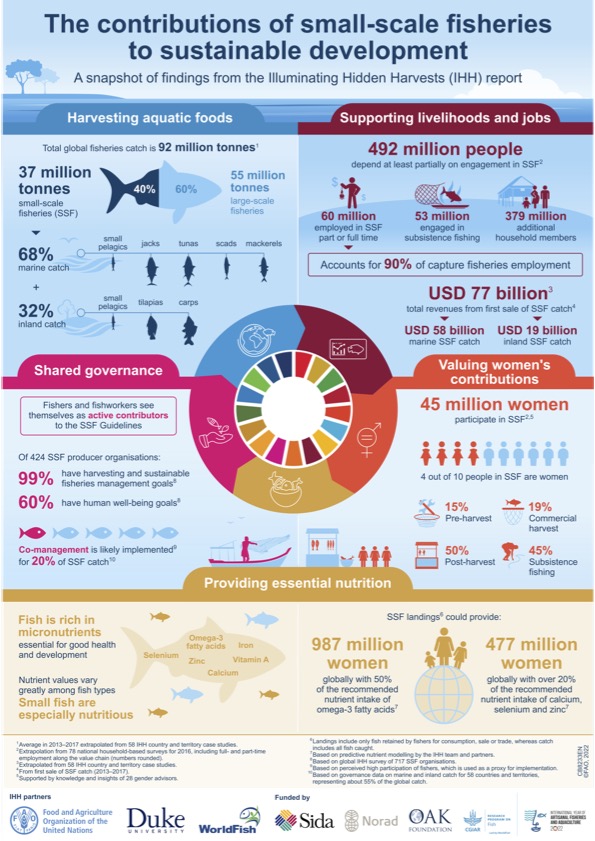
Partners: FAO, WorldFish, and Duke University – constitute the core study team, but there are many other potential collaborators.
- HH Pre-launch webinar: A snapshot of key findings
- IHH Website
—————————————————————————————————————————————–
2) Engagement and communication across multi-stakeholder groups in the context of sustainable fisheries
A crucial component of sustainable resource management is effective communication and translation of scientific evidence for sustainable practices to non-scientific audiences. The most recent example of this area is my work at the Sustainable Seafood Initiative at the Center for Marine Biodiversity and Conservation at Scripps Institution of Oceanography, where we are developing engagement programs with seafood purchasing representatives to provide knowledge needed to inform the design of new corporate policies that incorporate sustainable procurement practices for aquatic food products and provide a model for corporate responsibility that can be scaled to other seafood buyer stakeholder groups. Through these collaborations, we evaluate seafood procurement practices for warehouse club retail companies in thirteen countries in Central and South America and the Caribbean for aquatic food products from both capture fisheries and aquaculture. We have also developed a program that provides training for seafood buyers on the basic components and latest scholarship of sustainable production of aquatic food items from both fisheries and aquaculture. Programs like this are great examples for the contributions that research academic institutions can provide to bring awareness and understanding of our findings to audiences beyond the “ivory tower” and affect real change on the ground.
For more information on our Sustainable Seafood Initiative programming at Scripps, please review our website: https://cmbc.ucsd.edu/sustainable-seafood-initiative/
or contact me at manchaci@msu.edu
—————————————————————————————————————————————–
3) Institutional design of governance structures enabling sustainable resource management
A component of my research examines how institutions – policies, rules, or social norms – mediate the interactions between humans and natural resources, affect resource sustainability and equity outcomes, and can incentivize human adaptation and collective response to social and ecological change. The degree to which institutions can improve ecological and social outcomes is contingent on the larger contexts within which they are embedded, and requires clear understanding of the interdependencies between social, economic, ecological, and institutional processes affecting the design and implementation of resource management policies. Within this general framework, I integrate theory in political science, environmental management, and institutional analysis of social-ecological systems to examine questions like: (1) how effective is a given institution or policy instrument in governing social-ecological systems (e.g. in the context of fisheries management)? (2) how can we design institutions that improve the incentives for individuals and organizations to effectively adapt and collectively respond to social-ecological change?
Rooted in my training in governance and theory of common pool resource management, and following the tradition of Elinor Ostrom’s work on theoretical frameworks to study institutional arrangements, I primarily use a combination of quantitative and qualitative methods, such as coupled human-natural models, institutional analysis, and systematic conservation planning approaches to study institutions in comparative settings to ultimately propose policy and management alternatives and influence decision-making for resource management.
Dissertation research
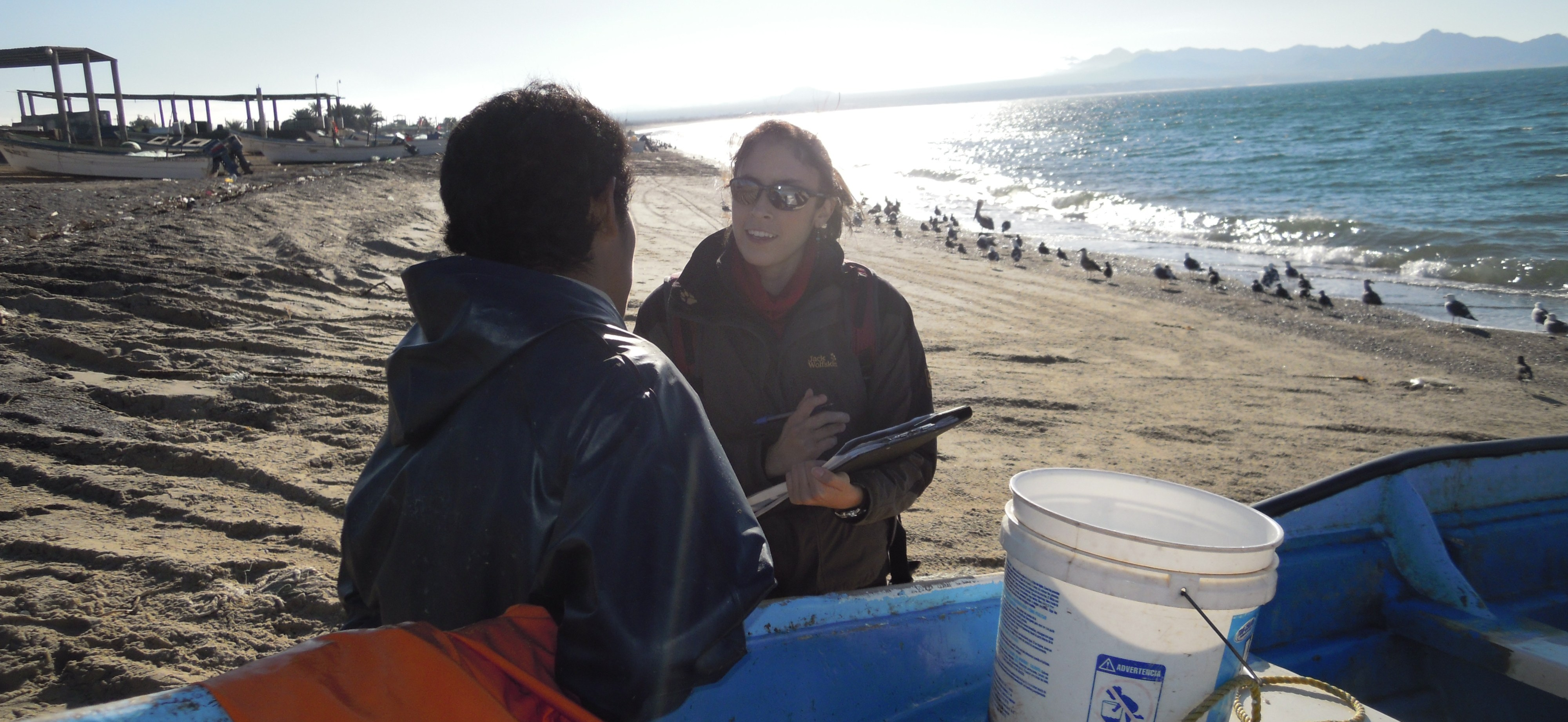
I graduated with a PhD in Environmental Life Sciences from Arizona State University in 2017. For my dissertation research, I used the Coupled Infrastructure Systems framework, following the tradition of Elinor Ostrom’s Institutional Analysis and Development framework, to better understand the interdependencies between social, economic, natural, and institutional processes affecting marine reserve implementation and performance efficacy in the Gulf of California (GOC), Mexico. I used a combination of qualitative methods and quantitative systematic conservation planning tools to evaluate the role of different types of infrastructures, institutions, and governance conditions for marine reserve implementation. These findings highlighted strengths and weaknesses within marine reserve systems that help understand what combinations of infrastructures can be influenced to increase effectiveness of management tools and their robustness to internal and external challenges, as well as delivering benefits for both nature and people. It also brings attention to the importance of understanding the roles of multiple infrastructures interacting dynamically within the various stages of marine reserve implementation and operation. An example of this work is published in Mancha-Cisneros et al. 2018. My PhD work was mainly supported by the CONACYT Doctoral Fellowship (2011-2016).
 Maria del Mar Mancha-Cisneros